Program Overview

About the MPA Program at NC State
Established in 1968, the Master of Public Administration (MPA) degree in the Department of Public Administration in the School of Public and International Affairs at NC State remains North Carolina’s only MPA available at our state’s capitol in Raleigh, NC. It is accessible to Washington, D.C., and is well-connected with local, state and federal government agencies, as well as nonprofits throughout our state and nation. As such, our program has access to a network of organizations and relevant connections to serve you in your graduate education and future career.
Accreditation. The MPA Program at NC State is accredited by the NASPAA Commission on Peer Review and Accreditation (COPRA) and is listed on the Annual Roster of Accredited Programs in conformity with NASPAA standards.

Alumni. You will be joining the proud ranks of over 2,000 alumni that are committed to efficient, effective, equitable and accountable public service throughout North Carolina, across the country and around the globe.
Track. Our program is a 36-hour track that focuses on practical and problem-solving skills and emphasizes public service values.
Full-time students typically complete the degree in two years; part-time students take from three to five years depending on work and personal obligations. Most classes are taught in the evening to permit full-time students to participate in internships and to accommodate the schedules of part-time students who work in public policy or nonprofit fields. NC State MPA does not offer a fast-track option.
Delivery. Face-to-face classes are taught on NC State’s Raleigh campus in the evening (6:00 p.m. to 8:45 p.m.) to permit full-time students to participate in internships and to accommodate the schedules of part-time students. Occasional online coursework is available as scheduled by the instructor.
MPA Virtual Information Sessions
Register for one of our Virtual Information Sessions held via Zoom using the links below to learn more about the MPA program. You’ll have an opportunity to hear from faculty, current students, and alumni about the program and learn about the application process.
- Wednesday, September 9, 2026, 6:00 p.m. – 7:30 p.m. (EST) – Registration link
- Thursday, November 12, 2026, 12:00 – 1:30 p.m. (EST) – Registration link
On this page:
MPA Degree Requirements
MPA students will complete 24 core hours and 12 elective hours. You will consult with your program advisor to choose electives that align with your interests and help you become a successful professional in the public or nonprofit sector.

Core Courses
- PA 510: Public Administration Institutions and Values
- PA 511: Public Policy Analysis
- PA 512: The Budgetary Process
- PA 513: Public Organization Behavior
- PA 514: Management Systems
- PA 515: Research Methods and Analysis
- PA 516: Effective Communications for Public Administrators
- PA 517: MPA Capstone
Electives
- PA 507: Public Policy Process
- PA 521: Government and Planning
- PA 522: Intergovernmental Relations in the United States
- PA 523: Municipal Law
- PA 525: Organizational Development and Change Management
- PA 530: Financial Management in the Public Sector
- PA 531: Human Resource Management in Public and Nonprofit Organizations
- PA 532: Contract Negotiation and Mediation in the Public and Nonprofit Sectors
- PA 535: Problem Solving for Public and Nonprofit Managers
- PA 536: Management of Nonprofit Organizations
- PA 539: Fund Development
- PA 540: Grant Writing for Public Administrators
- PA 546: Seminar in Program Evaluation
- PA 550: Environmental Policy
- PA 552: Science and Technology Policy
- PA 553: Disaster, Crisis and Emergency Management and Policy
- PA 598: Special Topics in Public Administration
Pre-service students are required to complete an internship as part of the 36 credit hour requirement. Find a detailed look at the program requirements in our student handbook.

Program Objectives
Develop students as managers with mission-relevant competencies
- Graduates are expected to be able to lead and manage in public governance.
- Graduates are expected to be able participate in and contribute to the policy process.
- Graduates are expected to be able analyze, synthesize, think critically, solve problems and make decisions.
- Graduates are expected to be able to articulate and apply a public service perspective.
- Graduates are expected to be able to communicate and interact productively with a diverse and changing workforce and citizenry.
Prepare students to be successful professionals in public service careers
- The MPA program includes a mix of pre-service and in-service students.
- The MPA program serves students from historically underrepresented groups.
- Graduates are satisfied with their elective specialty coursework.
- MPA internships develop students’ professional skills and prepare them for the job market.
- Graduating pre-service students are successful in job and internship placement.
- Graduating in-service students are able to apply concepts and skills from the MPA program to their public service job.
Tuition and Fees
Located in North Carolina, the MPA program at NC State University is a state institution and tuition rates are first set by the UNC Board of Governors and then approved by the North Carolina General Assembly. NC State’s Student Services Center’s Graduate Students page posts the most current and up-to-date tuition rates. Tuition and fees are charged at the beginning of the semester; additional mandatory health insurance charges will be billed unless you waive out of the premium charge.
The NC State Student Services Center provides many helpful tools for planning for your graduate finances, including a Graduate Student Estimated Cost of Attendance webpage to give you an estimate of annual expenses for full-time graduate students in different living situations as well as a Scholarship and Financial Aid page.
MPA Assistantships
The Department of Public Administration has a limited number of one-year graduate assistantships for full-time students who apply for the fall semester. The assistantships carry a stipend of $15,000 and tuition and health insurance through the Graduate Student Support Plan. All full-time students who apply by the priority deadline for the fall semester are considered for assistantships at the time they are admitted. The Internship Director works with students who do not receive financial aid to identify temporary jobs.
Students selected for assistantships will be notified by January 30, 2026. The Internship Director works with students who do not receive financial aid to identify temporary jobs.
MPA Internships
Internships provide first hand, real world experience for students and are a great resume builder. In 2025, Princeton Review ranked NC State #15 among public universities for providing internship opportunities for their students. All pre-service MPA students are required to take the PA 650: Internship in Public Affairs course. In-service students may also pursue an internship for course credit by taking PA 651: Advanced Practical Training. Our program has an External Relations and Internship Director who specializes in placing our students in relevant career-building opportunities. Find out more on our MPA Internships and Jobs page.
Partner with the NC State MPA Program
Organizations can partner with NC State’s MPA program in the following ways:
– Hosting and MPA Intern
– Hosting a Field Trip
– Sponsor faculty and student research
– Be a guest speaker
To learn more, please see our Partner with Us document.


Engaged Community
Faculty
The department of Public Administration is proud of its dedicated faculty and their commitment to student success. We have 13 full-time tenured and tenure-track faculty who are all academically qualified, possessing doctoral degrees in relevant disciplines and serve in a variety of roles on both the campus, state as well as national agencies. They understand the complex challenges that government and nonprofit sectors face in a rapidly changing world and enjoy engaging with our students. Our faculty specializes in subjects such as: collaborative governance, emergency and natural disaster response, public safety leadership, public management, public policy, sustainable energy systems and policy, genetic engineering, multi-agent collaboration and inter-organizational relationships, wicked problem solving, phosphorous sustainability, international non-governmental organizations, and nonprofit management and leadership. You can read more about them on our faculty webpage.
The program’s instructional faculty also includes professionally-qualified public service practitioners. These practitioners are selected based upon their professional roles and experiences.
Program Contributors
Dr. Meggie Romick is the program’s Academic Advisor and Program Coordinator and has been with the department for more than 8 years.

Dr. Tracy Appling is SPIA’s Director of External Relations and Internships and helps MPA Students find suitable internships.


Other Course Tracks
Certifications
The department offers two graduate certificates, one in nonprofit management and the other in policy analysis.
Dual Degrees
MPA/JD
The MPA/JD dual degree program allows students to earn their JD from Campbell University’s Norman Adrian Wiggins School of Law. The dual program allows both degrees to be completed in four (4) years, where students complete the JD curriculum and take an additional 27 credit hours of MPA courses to complete the requirements. Of the courses from the MPA program, 24 of the credit hours must be earned by completing the program’s core courses. Students interested in the dual program are encouraged to speak to the admissions counselors at the School of Law regarding admission into the JD program. Law students wanting to add the MPA degree typically apply for admission to the program during the first year of law school and complete most of their MPA core courses during their second year of graduate study.
MPA/MIS
The MPA/MIS dual degree program allows both degrees to be earned from within the School of Public and International Affairs at NC State University, where the Department of Public Administration is located. To earn both degrees students must complete a total of 60 credit hours across both programs. Students in the dual degree program will take 24 credit hours of the MPA program’s core courses and will also take 18 hours of credit from the MIS program, including 15 hours from the MIS program’s core courses. An additional 18 credit hours can be taken from MPA or MIS classes to complete the total credit requirement. The dual MPA/MIS can be added to a student’s Plan of Work at any point prior to their graduation from the program they initially matriculated into.
MPA/MSW
The Department of Public Administration and the Department of Social Work at NC State allow students to complete both the MPA and the MSW programs simultaneously. To be considered for the dual degree program, students must be accepted into the Advanced Standing option of the MSW program. To complete the dual program, students take a total of 54 credit hours. Twenty-four (24) of these credit hours come from the core courses of the MPA program. The remaining 30 credit hours are taken from the MSW program. To enroll in the dual MPA/MSW program, students must first be accepted into the MSW’s Advanced Standing program and then apply for the MPA to be added as a secondary degree. For more information about the dual program, students are encouraged to speak to both the director of the MSW and MPA programs.
Multiple Master’s Programs
University policies governing the transfer of courses into graduate programs require students to take a minimum of 48 credit hours to receive two unique degrees. (More credit hours may be required depending on the requirements of the degree programs.) Students pursuing two Master’s degrees must meet all Graduate School requirements and the requirements of each degree program. This memo outlines the general framework for pursuing two Master’s degrees conterminously.
Students interested in pursuing an MPA and a second master’s degree should contact the MPA director, who can help with the logistics and start laying out a plan. The process is easier than it looks.
How to request admission
- Send a memo to the MPA Director indicating that you want to pursue a second NC State University Master’s degree coterminous with your MPA degree. (Include the name of the degree in your memo.) Similar to the personal statement submitted with your MPA application, this memo should state your professional reasons for pursuing a second Master’s.
- After the MPA Director approves the request, the PA Graduate Services Coordinator will send the DGP of the second Master’s program: (1) a copy of your memo approved by the MPA Director, (2) copies of the relevant sections of your file (all transcripts, GRE scores, and letters of recommendation), and (3) a request that the second program consider you for admission. You are responsible for supplying the other program with any additional materials they required to make a decision.
- The second program’s admissions committee will review your file and inform you and the MPA Director if you have been recommended for admission. If you are denied admission by the second program your request will not be approved. If you are recommended for admission, the DGP of the second program will send the Change of Degree Status or Curriculum form to the Dean of the Graduate School indicating the recommendation.
- The Dean of the Graduate School will notify you and both Programs if your request for admission to the second program was approved.
Filing your plan of work
University policies assume a 30 credit hour master’s degree. Because the MPA is a 36 credit hour degree, you may be able to include over the university minimum as part of both degree programs. The following policy will expedite approving your plans of work:
- Students must submit separate plans of work through the Student Information System (SIS). After your admission to the second program has been approved, the Graduate School will set up a second “career” (this is SIS language for degree program/plan of work) in SIS. Once both careers are established, you can add courses to the separate plans of work, both of which must meet the respective requirements of the specific degree programs.
- Once entered and submitted, the proposed plans of work will be routed electronically to the respective program advisors and Directors for approval.
- Multiple masters students must also submit two Patent Agreement Forms to the Graduate School, one for each degree program.
Specializations
The Master of Public Administration program at NC State does not offer formal specializations. Instead, the program affords students the opportunity to tailor individualized public service specialties consistent with their interests and abilities, the university’s strengths, and labor market needs.
The MPA program offers elective coursework in public management, nonprofit management, urban management, financial management, organizational leadership, policy analysis, and justice administration.
Inter-Institutional Program
MPA students may also take electives in other departments at NC State or, through the Inter-Institutional Registration Program, at other North Carolina Schools including UNC-Chapel Hill, Duke University, NC Central University, UNC Charlotte, or UNC-Greensboro.

Admission Info
The program is selective, seeking a mix of pre-service and in-service students from a wide range of backgrounds to contribute to the wealth of the program. We require a minimum 3.0 (GPA) to apply.
Prospective students apply through the NC State Graduate School (see our How to Apply webpage for full information).
Completed applications include a personal statement, resume, transcripts and three letters of recommendation. Additionally, international applicants must demonstrate proficiency of English.
Please note that we do not require the GRE.
Application Deadlines
Fall Admission
- January 10 – Priority deadline for graduate assistantship
- March 1 – Final deadline for international applicants
- June 25 – Final deadline for domestic applicants
Spring Admission
- November 1 – Final deadline for domestic applicants
- July 15 – Final deadline for international applicants

Program Outcomes and Facts
In April 2025, our MPA Program retained strong rankings in U.S. News & World Report’s list of “Best Graduate Schools.” We ranked #27 in Nonprofit Management and #61 in Best Public Affairs Programs.
In 2025, Princeton Review ranked NC State #15 among public universities that provided internship opportunities for its students.

MPA Fast Facts
What is the program size?
The MPA program currently has 79 students (Fall 2025).
What is the completion rate for the MPA program?
Our ARY-5 Cohort Data for the MPA program enrolled 43 students for the 2020/21 academic year: 21 graduated within 2 years of enrolling, 28 graduated within 3 years, and 32 graduated within 4 years of enrolling. Thirty-two students in total graduated or persist to graduation.
Where are MPA graduates employed?
Our students are employed in positions in local, state, and federal governments, nonprofits, higher education, the corporate world, and/or have continued on with their education. 53% of Preservice Student Internships turned into full time employment. The job placements for 2024 – 2025 MPA graduates are:
- Federal Government – 0
- State Government – 9
- Local Government – 7
- Private/Research – 1
- Nonprofit – 7
- Continued Education – 1
- Unemployed (seeking employment) – 1
- Status Unknown – 1
- TOTAL GRADUATES – 27
Some examples of where our students have been placed include:
| Local Gov. | State Gov. | Federal Gov. | Nonprofits |
|---|---|---|---|
| City of Raleigh | NC General Assembly | U.S. Department of Veterans Affairs | Autism Society of North Carolina |
| Town of Wake Forest | NC Department of Adult Correction | U.S. Committee for Refugees and Immigrants | Haven House |
| City of Greensboro | NC Department of Health and Human Services | U.S. Department of Defense | Activate Good |
| Wake County Libraries | NC Association of County Commissioners | National Institute of Environmental Health Sciences | SPCA |
| City of Hickory | NC Office of State Budget and Management | U.S. Department of Labor | Breakthrough T1D |
| Town of Wake Forest | Junior Achievement of NC | U.S. Department of Treasury | Carolina Performing Arts |
Student Life
our students shine

Seeby Jarvis-Earle awarded MPA Scholarship

Kaili Matico awarded MPA Scholarship

Rania Hassan
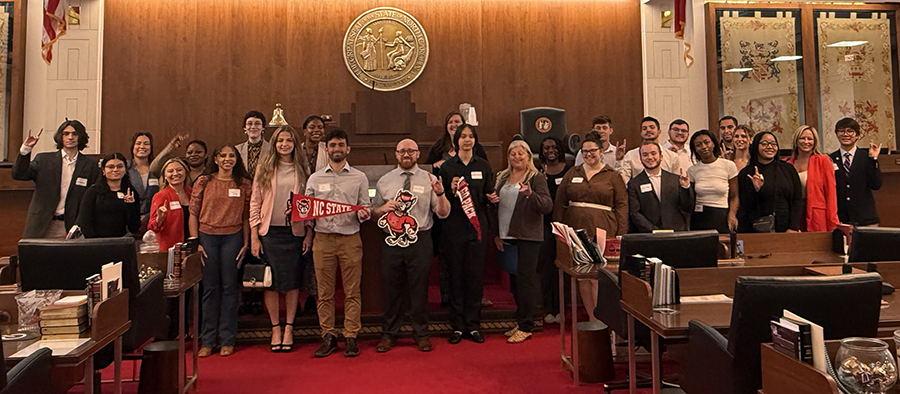
MPA Students visit General Assembly
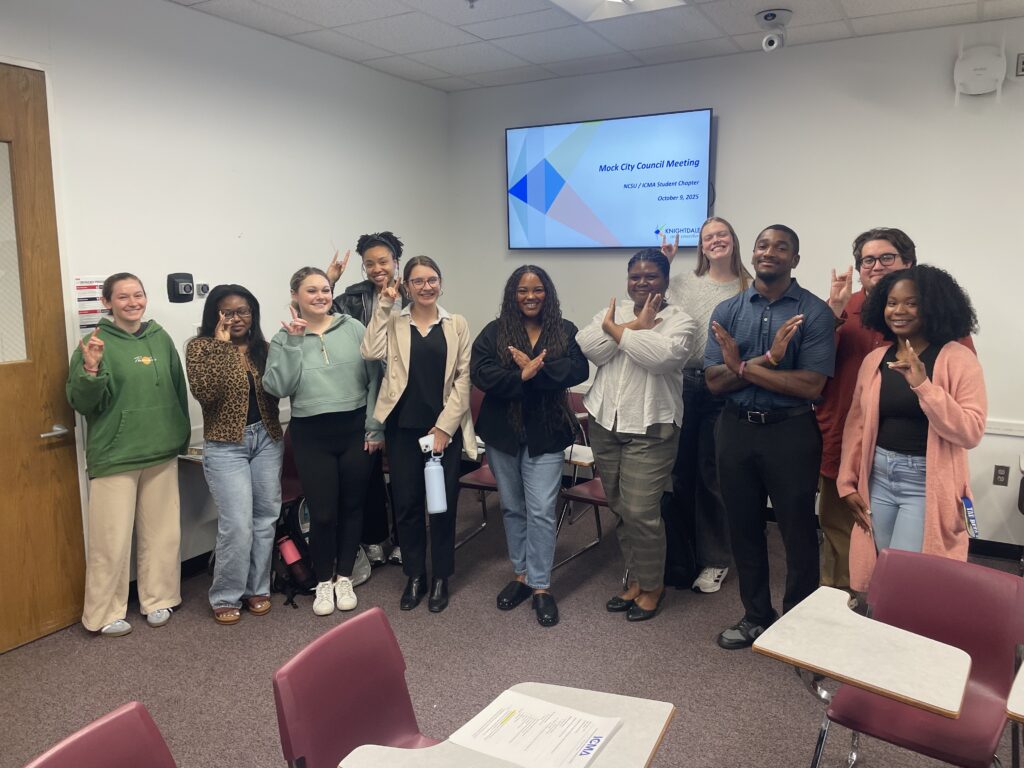
NC State’s ICMA Student Chapter Hosts Mock City Council Meeting
On October 9, 2025, MPA students who are members of the NC State Student Chapter of ICMA hosted a “Mock City Council Meeting” event.
They were joined by ICMA Chapter Students from North Carolina Central University for an engaging discussion. Expert input was given by Bill Summers, town manager of the Town of Knightdale, and Rachel Morris, director of community relations for the Town of Knightdale.
Together, they explored the importance of local government and how it directly shapes the communities we live in. The conversation touched on the roles of stakeholders in city council meetings, how decisions are made at the local level, and the value of civic engagement from both professionals and residents alike.
NC State Pi Alpha Alpha 2025

Admitted Students Day

TUESDAY, FEBRUARY 10, 4 – 6 P.M.
NC STATE CAMPUS, CALDWELL HALL
The Department of Public Administration is excited to welcome all admitted students to Admitted Students Day on Tuesday, February 10, from 4 to 6 p.m. in Caldwell Lounge at Caldwell Hall.
At our Admitted Students Day, we aim to provide useful information about life as an NC State Student in the School of Public and International Affairs. From our recently-revised MPA Core Curriculum, to our internship services, to our positive culture of invested mentoring, you can expect to find a place where you are welcomed and championed here at NC State.
We understand that your decision on your advanced degree is a vital one, and we hope you come visit and find our close-knit environment a place to call your new home.
At Admitted Students Day, you can expect to:
- Hear from current students about why they chose our MPA program and how it is helping them develop the future course of their career.
- Visit faculty about their fields of expertise and learn about how to tailor your program to your individual needs and goals.
- Talk with advisors on many of NC State’s campus offerings that enhance your education and give you opportunities for specialized growth.
- Sit in on one of our classes to experience what our program is like.
We hope to see you there!
Testimonials
Shannon Taitt (MPA 1994)
“My favorite part of the MPA program was building lifelong friendships with two of my closest classmates, who came from different racial and ethnic backgrounds and religious faiths. Our conversations during our graduate assistantship broadened my perspective, helping me appreciate diverse viewpoints. This experience has shaped my approach to hiring strong and capable talent and developing public health programs, ensuring inclusivity, collaboration, and a deeper understanding of the communities we serve.” – Read more on this Alumni.

J.R. Griffin II (MPA 2024)
“Coming into the program with several years of experience in government, the MPA program amplified my skills with the vocabulary and tools necessary to improve my job through efficiency and knowledge.” – Read more on this Alumni.
